





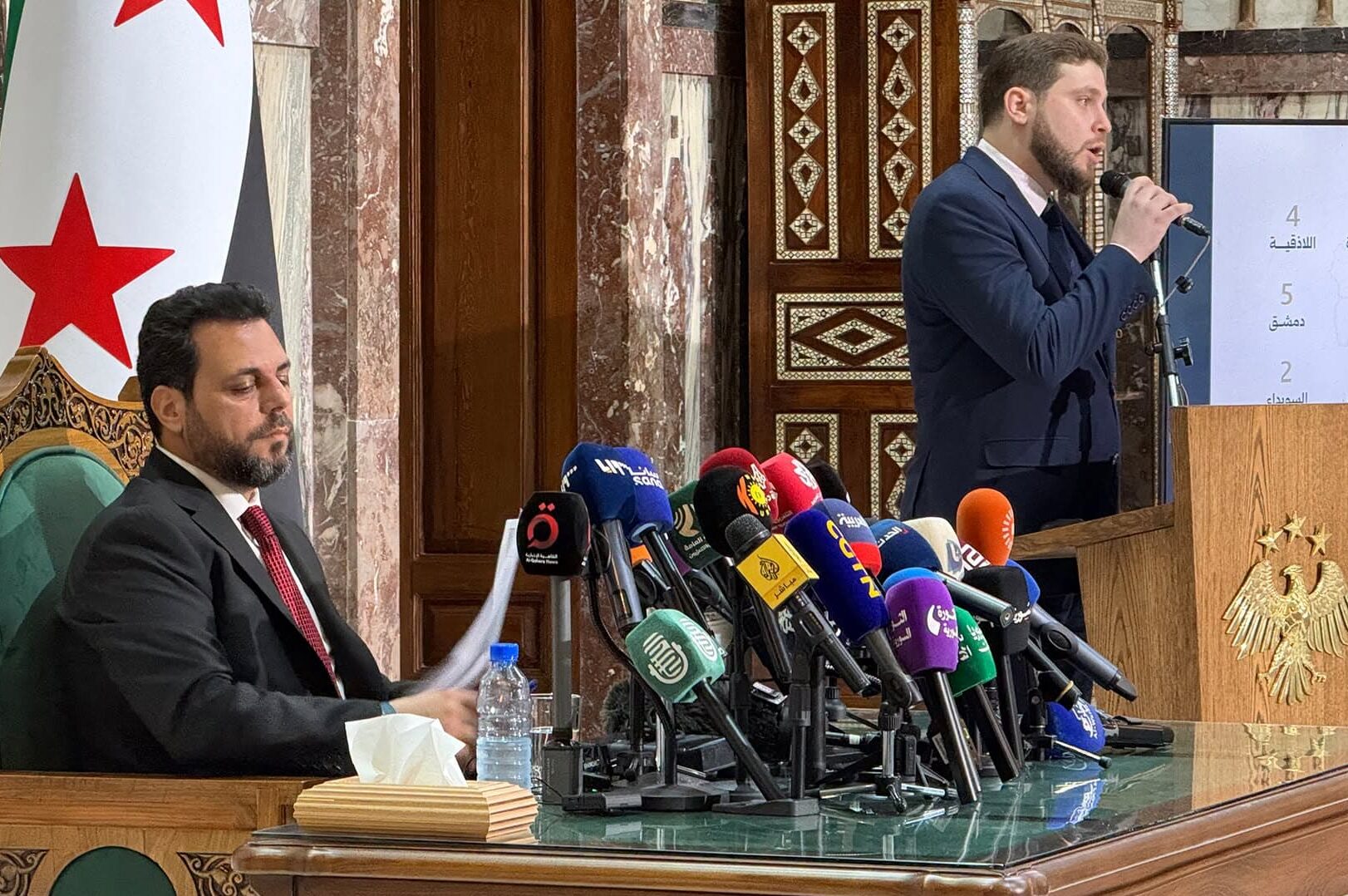
Syria’s interim President Ahmed al-Sharaa has appointed the remaining 70 members of the country’s transitional People’s Assembly, completing the formation of the first parliament since the fall of the Assad government and paving the way for its inaugural session next week.
The new legislature consists of 210 members, with one-third appointed directly by the presidency and the remaining 140 selected through indirect elections conducted over recent months. Under Syria’s transitional constitutional framework, the parliament will serve a renewable 30-month term and is expected to review existing legislation, pass new laws and participate in drafting a permanent constitution.
Among Al-Sharaa’s 70 appointees are only three Kurdish figures: Abdulhakim Bashar of the Kurdish National Council (ENKS), along with Mustafa Abdulrahman Abdi and Yasir Sulaiman Mansour, both regarded as politically close to the interim administration. Mansour is the brother of Ahmad Hilal, the deputy governor of Hasakah and one of Damascus’ senior officials overseeing the implementation of the integration process in northeast Syria.
Nine additional Kurdish representatives secured seats through the indirect elections held in northeast Syria, bringing Kurdish representation in the new assembly to 12 members—roughly 5.7 percent of the chamber.
The presidential appointments include 55 men and 15 women. Geographically, the appointments are distributed across Syria’s governorates, with Aleppo receiving the largest share (14 seats), followed by Hasakah (7), Deir ez-Zor and Homs (6 each), Idlib, Hama, Damascus and Rural Damascus (5 each), Latakia and Daraa (4 each), Raqqa (3), and Tartous, Suwayda and Quneitra (2 each).
The Kurdish-led Syrian Democratic Forces (SDF) did not officially participate in the indirect elections, although local reports suggested the group supported several independent candidates. None of Al-Sharaa’s presidential appointees are publicly affiliated with the SDF.
Kurdish politicians have criticized the outcome, arguing that representation falls well below the Kurdish share of Syria’s population. ENKS official Sulaiman Oso said Kurds constitute approximately 15 % of Syria’s population but will hold only around five percent of parliamentary seats. Despite his criticism, Oso expressed hope that Kurdish lawmakers would advocate for constitutional recognition of Kurdish rights and official status for the Kurdish language in Kurdish-majority areas.
The parliament is expected to hold its first session on Monday, when members will take the oath of office and begin legislative work under Syria’s transitional constitutional framework.
From armed autonomy to political integration
The composition of the new parliament reflects the profound shift in Kurdish politics that has unfolded since early 2026.
Following its withdrawal from several frontlines in January, the Kurdish-led SDF entered into an agreement with Damascus that launched a process of military and administrative integration into the Syrian state. On 30 January, both sides announced a comprehensive integration framework that envisioned the gradual incorporation of SDF military units and civil institutions into the Syrian state while providing guarantees for Kurdish cultural and educational rights. The agreement also provided for the deployment of state institutions in major northeastern cities and established mechanisms for integrating local administrations.
For many observers, the agreement marked a significant departure from the Kurdish movement’s long-standing political project of autonomous self-administration in northeast Syria, commonly known as Rojava. Since 2012, Kurdish authorities had developed parallel political, military and administrative institutions largely independent of Damascus. The integration process launched in 2026 has shifted the focus from preserving separate governing structures toward negotiating Kurdish participation within Syria’s unified state institutions.
However, implementation has progressed unevenly. While security coordination and some administrative integration have advanced, Kurdish officials have repeatedly voiced concern over delays in fulfilling political commitments, including constitutional guarantees, local governance arrangements and broader Kurdish representation within national institutions.
The limited number of Kurdish lawmakers in the transitional parliament is therefore likely to reinforce concerns among many Kurdish political actors that, despite the integration agreement, Kurdish influence over Syria’s constitutional transition remains constrained.
