



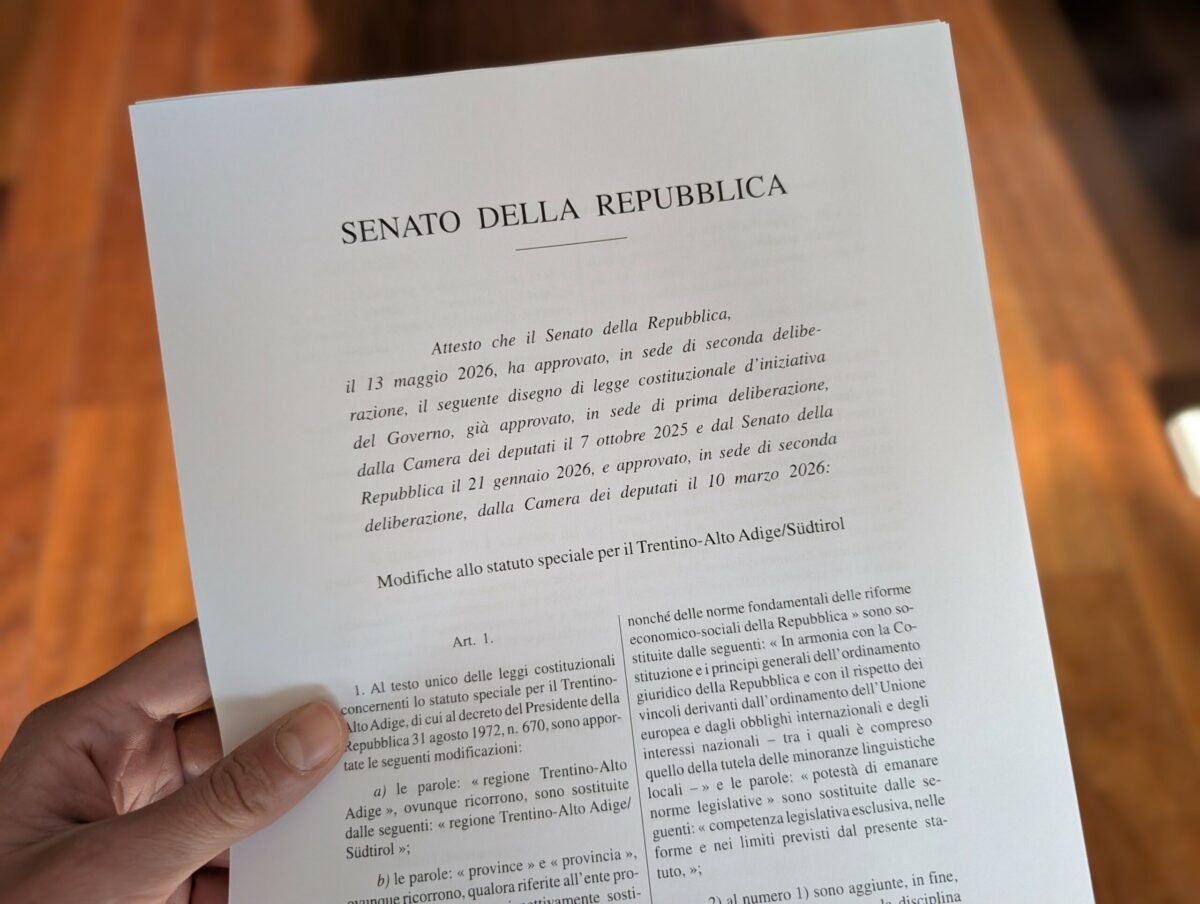
In recent years, South Tyrol has been striving to preserve its autonomy within a Italy that pursues centralising policies. The region’s years-long efforts are finally paying off. The Italian Senate approved the reform of the South Tyrol Statute on 13 May.
In the Senate vote, 129 senators voted in favour of the new statute and 48 abstained. The statute reform had previously been approved by the Italian Parliament.
The statute reform restores and clarifies the competencies of South Tyrol that had been weakened by Italy. Italy’s Constitutional Court had initiated the centralisation process in 2021, and Rome had gradually curtailed South Tyrol’s legislative powers. This occurred, in particular, in the unclear area where the duties of the state and the region overlapped.
Strengthened powers and legal clarity
In the new statute, South Tyrol’s autonomy is redefined through the sharing of powers between Italy and the region. This ensures that the autonomy, which was won after decades of struggle, is protected.
The reform was the result of negotiations between the Italian government, led by Prime Minister Giorgia Meloni, and representatives of South Tyrol.
Austria expresses satisfaction
Austria, which neighbours South Tyrol, welcomes the reform with pleasure. The country’s government states that the reform is a step towards safeguarding South Tyrol’s autonomy model. Austria became a guarantor of South Tyrol’s autonomy with the 1946 Paris Agreement.
On the other hand, the South Tyrol People’s Party (SVP) had been striving for this reform for years and is therefore satisfied with the outcome.
However, the reform has faced criticism from the Austrian Freedom Party (FPÖ), which represents the radical right. The party says that as a result of the reform, the German-speaking region of South Tyrol will gradually become ‘Italian’.

South Tyrol’s autonomy
South Tyrol is a German-speaking region in Northern Italy, situated on the border with Austria. The region has an area of 7,399.97 km² and a population of around 530,000. 62.3% of the population speak German, 23.4% Italian and 4.1% Ladin.
South Tyrol was granted autonomous status in 1948 after a long-running dispute, but the conflict only ended with the 1972 autonomy agreement. The most interesting aspect of South Tyrol’s autonomy is its language quota system. Members of each language group are represented in official jobs and public services in proportion to their population.
