




By Samî Tan
Under the historic “Eastern Reform Plan” (Şark Islahat Planı), the Kurdish language was explicitly banned. While this prohibition had a limited impact on rural village life, villagers faced severe fines whenever they entered the cities for trade. In some cases, the market value of the produce they sold was not even enough to cover the penalty imposed for speaking their native tongue. Many stories and anecdotes stem from this era. As one tale goes, an unilingual Kurdish villager went to a city shop and, desperate to avoid a financial penalty, blurted out to the shopkeeper: “Five kilograms of sugar—in Turkish.”
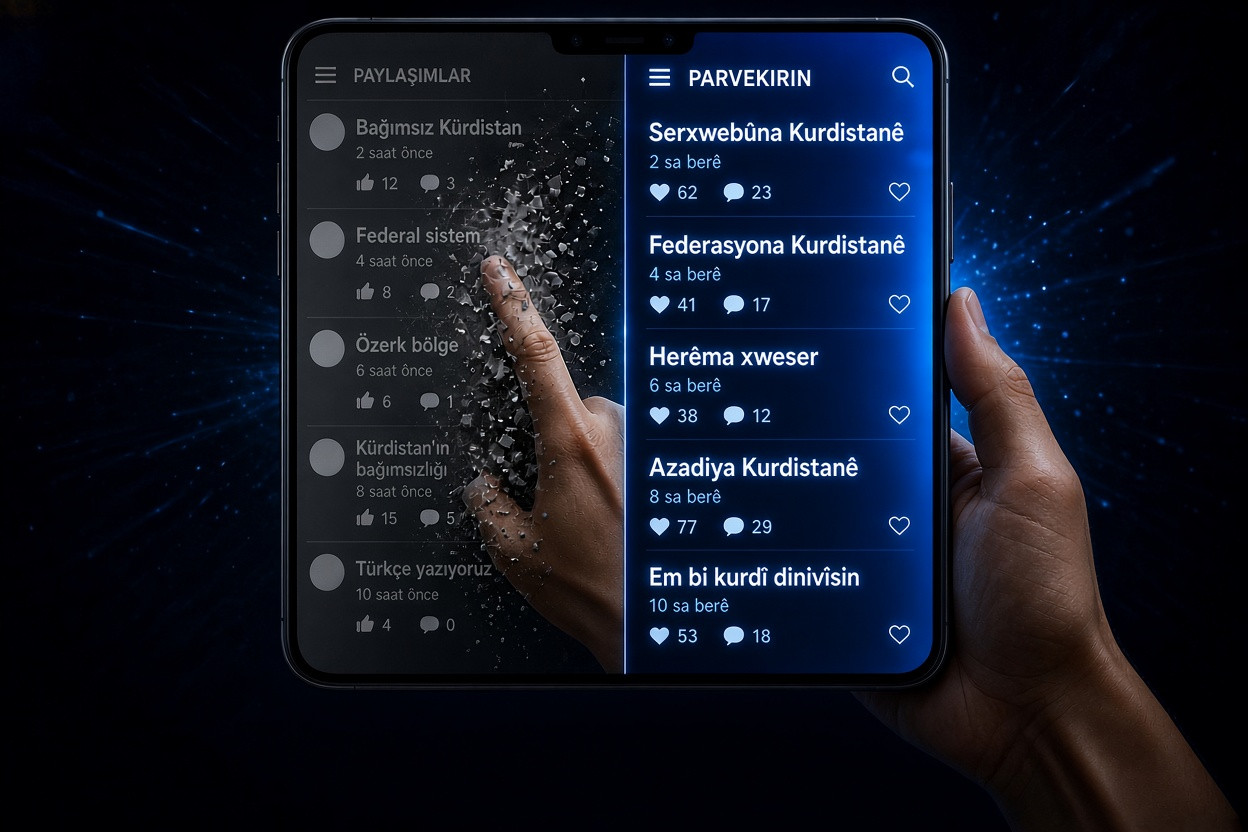
This anecdote frequently comes to mind whenever I observe current discussions across social media. Thousands of articles and commentaries are published online demanding a federal system or an independent Kurdistan, yet roughly 90 percent of them are written in Turkish. Why? Wouldn’t it be far more constructive if these writers, instead of dizzying readers with endless streams of Turkish text, sat at home and devoted their energy to learning or improving their Kurdish?
From historical bans to digital assimilation: The Turkish paradox
This affliction among Kurdish intellectuals is by no means new. Writing in the early 20th-century publication Rojî Kurd, intellectual Xelîl Xeyalî highlighted this exact paradox: “No matter how much I ponder it, I cannot fathom why our scholars and educated elites converse in Kurdish and study religious texts in Kurdish, yet when it comes to writing their personal letters or official deeds, they resort to Arabic, Persian, or Turkish.”
Regrettably, today the crisis extends beyond writing—it has invaded daily speech. A vast number of oral broadcasts, podcasts, and digital shows are produced entirely in Turkish. One only needs to look at social media discussions to see the extent of this shift. Figures like Turkish ultra-nationalist Ümit Özdağ publicly boast that Kurdish children in border villages—and even outside Turkey’s borders—now speak Turkish. During an episode of our program Deng û Reng, guest Fewzî Ciwan noted with dismay: “Even in the high pastures of Mount Ararat, children now play their games in Turkish.” This is the harsh reality we face.
Meanwhile, self-proclaimed pro-independence writers continue to advocate for Kurdish freedom in Turkish. Why? Some simply do not know Kurdish. Despite decades in Kurdish politics and advocating for an independent Kurdistan, they have never taken the time to master their own language. Others can speak their local village dialect but remain illiterate in the Kurdish alphabet. Some feel articulate, sophisticated, and expert when speaking Turkish, but feel “ignorant and uneducated” the moment they switch to Kurdish. Still others argue: “When we post in Kurdish, ten people read it; when we post in Turkish, a thousand people read it.” While the reach might be larger, this approach yields no real benefit for the Kurdish national cause and only drives people further away from their language.
Language as the foundation of the Kurdish identity and freedom
What would happen if Kurdish independence advocates declared a digital boycott of Turkish on social media? Some might react by saying, “Let Abdullah Öcalan and his movement do it first.” My response is simple: Why wait for them? By your own claim, they no longer champion this national cause—so why expect them to lead such a boycott? Why not take the initiative yourselves for once?
If everyone demanding Kurdish national rights made all their social media posts, debates, and interactions exclusively in Kurdish, the mental and emotional borders drawn by occupying forces would begin to crumble, shifting our collective national agenda.
Whether for an independent state, a federal system, an autonomous region, or even peaceful coexistence on equal terms, a strong Kurdish identity is indispensable. And that identity can only be built upon the foundation of the Kurdish language and culture—never on Turkish.