



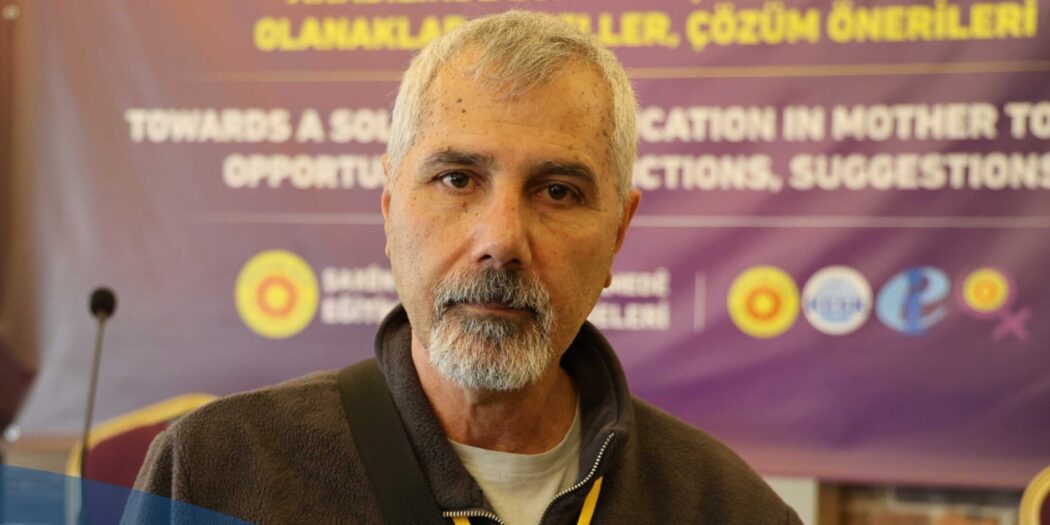
The book Language: Being and Non-Being by linguist Samî Tan was recently published. In the book, Tan once again demonstrates, through numerous examples, why Kurdish occupies an important place among the world’s languages. A few days after the publication of the book, Kurdish Language Day was celebrated, once again bringing the issue of preserving Kurdish to the forefront of public debate. We spoke with Tan about the value of the Kurdish language and recent efforts to preserve and strengthen it.
You begin your book by introducing Kurdish with the phrase, “To love something, one must first know it.” What are the main characteristics that place Kurdish among the world’s significant languages?
In truth, no language is inherently inferior or superior to another. Every language takes on the colour of its speakers and, through its unique structure, shapes their thoughts and lives. The Kurdish language, with all its dialects and sub-dialects, has carried its existence into the present day across the geography historically known as Kurdistan.
When we examine historical documents, we see that “Kurdish” once served as an umbrella term for many of the languages and dialects spoken by the peoples of north-western Iran. Kurdish has preserved many important characteristics of the north-western Iranian language family. For example, Kurdish has retained the semi-ergative structure found in these languages, as well as grammatical gender — features that Persian no longer preserves.
The Kurdish language developed in harmony with the nature of Kurdistan and the needs of Kurdish social life, giving it a rich vocabulary. Furthermore, Kurdish morphology allows for the creation of new words and concepts in response to the evolving needs of society.
In your book, you write: “Although there are no written documents concerning ancient Kurdish (proto-Kurdish), it is nevertheless an ancient language.” Is the antiquity of the language enough to guarantee its future survival?
Languages do not survive simply because they are ancient. Antiquity alone is not enough. The fate of the Kurdish language lies in the hands of the Kurds themselves. A language flourishes, develops, and survives through its speakers — especially through new generations.
Sometimes, antiquity itself can even become an obstacle to development; certain linguistic features may become burdens over time. When we say that the fate of Kurdish is in the hands of the Kurds, we must also recognise that the fate of the Kurds is tied to the condition of their language.
A language, like society, must renew itself and adapt to changing times. The development of a society and its language go hand in hand. But if a society abandons its own language and continues life through another, then no one can save that language from decline.
In the third section of the book, you write that “after the 2000s, especially Diyarbakır and the cities of Kurdistan became centres of Kurdish intellectual life.” Yet today, only twenty years later, these same cities are increasingly associated with linguistic erosion and assimilation. How do you explain this shift?
Linguistic developments are closely connected to political and social developments. As we have said before, the fate of the Kurdish language and the fate of the Kurdish people are intertwined.
Between 2013 and 2015, important progress was made in language work. However, when the so-called “resolution process” collapsed and conflict resumed, dark clouds also gathered over efforts to promote Kurdish. Many institutions were shut down, and many of the gains achieved for the language were lost.
Today, however, a new phase appears to be emerging. The activities organised this year for the Kurdish Language Festival are signs of renewed energy. What Kurdish still lacks today are official status and the right to education in the mother tongue. These rights can only be achieved through a strong, united, and civil democratic struggle.
In your book, you briefly mention the Kurdish Hawar Group, describing it as “the first initiative aimed at building a civil-democratic movement.” Could you tell us more about this initiative?
The Kurdish Hawar Group was announced in 2005 by teachers and students of the Istanbul Official Course. They also published a manifesto, which I discuss in the book. Unfortunately, at that time the Kurdish political movement had not yet reached the level of maturity necessary to embrace and support such an initiative, from which a broader national language movement might have emerged.
You also write that TZP Kurdî attempted to make the struggle for Kurdish a strategic dimension of the Kurdish people’s democratic struggle. To what extent did the movement succeed?
TZP Kurdî occupies an important place in the history of the Kurdish struggle. Within a few years, it succeeded in placing language awareness and the struggle to protect and develop Kurdish firmly on society’s agenda. Many organisations were established, people were trained, and educational materials were produced.
However, for similar reasons to those that weakened the Kurdish Hawar Group, TZP Kurdî also came under political and ideological pressure. Over time, the movement narrowed and lost momentum. Eventually, even its name disappeared.
One of its major failures concerned its stance on Kurdish language classes and optional education programmes. This created a deep division among Kurdish language advocates and supporters.
In many countries, language movements form part of broader nation-building projects. In the Kurdish context, however, the main political movement increasingly emphasises “integration” rather than the earlier concept of “democratic autonomy.” How might this affect efforts to protect and revive Kurdish?
As far as I understand, the political movement has not abandoned its demand for status — especially for the Kurdish language. Nor has it reduced this issue to a bargaining chip in negotiations with the state.
Today, political and social circles broadly agree that the Kurdish struggle must continue through democratic means rather than armed conflict. If an armed movement lays down its weapons, what else can it do except continue pursuing Kurdish rights through political and democratic struggle?
At the same time, those who opposed the armed struggle have long argued that conflict prevented their own work from flourishing. If that is the case, then this new phase should allow them greater opportunity to develop their efforts as well.
Finally, what would you like to say about the future of the Kurdish language?
Kurdish patriots, regardless of organisational affiliation, continue to demand national rights, including official recognition and status for both the Kurdish people and the Kurdish language.
In conclusion, Kurdish patriots — regardless of their political affiliation — continue to demand national rights, including official recognition and status for both the Kurdish people and the Kurdish language. Rather than fighting among themselves, each group should focus on contributing in the most constructive and effective way possible, allowing the people to decide which ideas and approaches best represent them. Our strength lies in unity, and that unity is what will preserve both our people and our language. Kurdish society is diverse and pluralistic; no one should impose their “own truths” on others.
