






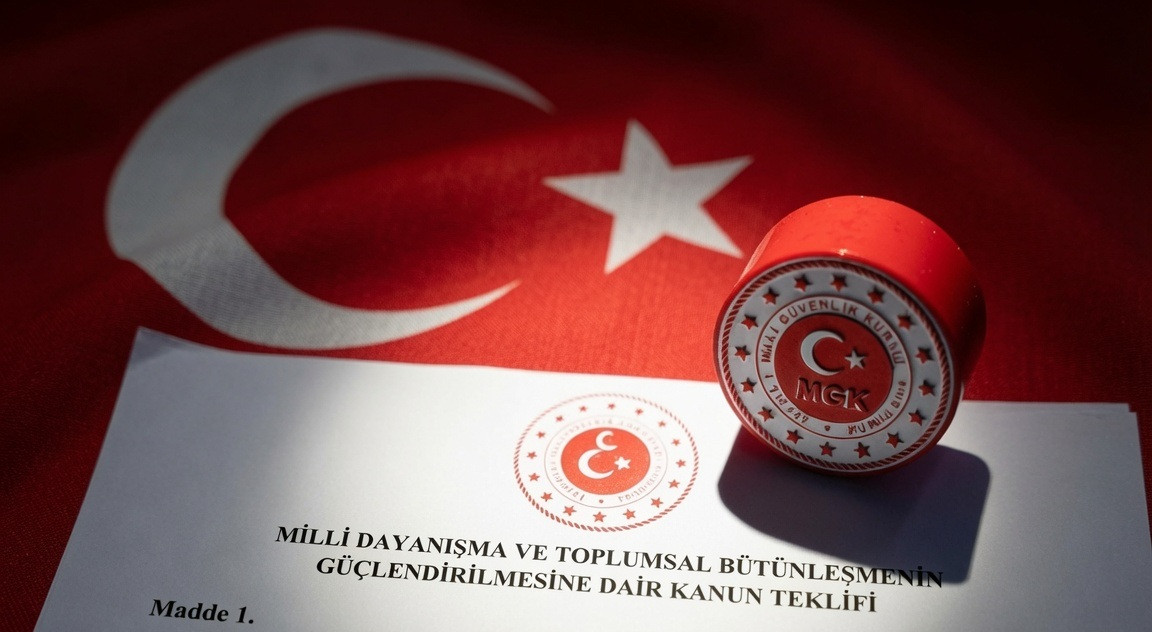
The initial legal step has been taken in the renewed process involving the Turkish government, Abdullah Öcalan, and the DEM Party. Although all involved parties frame this step as a technical and legal necessity, the draft text indicates that the state restricts the scope of any potential solution to amnesty and the dropping of legal prosecutions. Crucially, it side-steps the most fundamental aspect: constitutional recognition and legal status for the Kurds.
According to the details of the framework draft, the law will not take effect immediately upon parliamentary approval. For the legal mechanism to proceed, Turkish security institutions and the National Intelligence Organization (MIT) must first officially verify the complete cessation of the PKK’s presence and the total surrender of its weaponry. Following this verification, the National Security Council (MGK) must approve the determination and publish it in the Official Gazette.
This multi-step conditionality demonstrates that the state does not view political dialogue or a broad national consensus as the foundation of the process. Instead, the initiative operates entirely under the definition, control, and discretion of the state’s security doctrine, demanding total military surrender as an indispensable prerequisite.
Technical demilitarization vs. structural reform
The broader trajectory of the state’s strategy reveals an effort to prevent the discussion from expanding into democratic principles and Kurdish rights recognition. The text of the bill contains no provisions for:
-
Constitutional recognition of Kurdish identity or Kurdistan,
-
Guarantees for mother-tongue education,
-
The right to local and regional self-governance,
-
The abolition of the appointed trustee/governorate system.
Through this approach, a historical conflict spanning over a century is reduced to a technical procedure focused solely on demilitarization.
Executive control and institutional oversight
Under the proposed legislation, a specialized committee chaired by the Vice President, alongside a 17-member Parliamentary Follow-up Commission, will be established to manage and monitor the process. Meanwhile, public debate continues regarding statements by MHP Leader Devlet Bahçeli concerning the “right to hope” and the potential reinstatement of ousted co-mayors.
Despite these discussions, critics maintain that the 12-point document is part of a calculated state strategy aimed at neutralizing the national demands of the Kurds. Upcoming developments will clarify whether this initiative remains strictly confined to security protocols or opens the door to substantive debate on constitutional rights and civil politics.
