





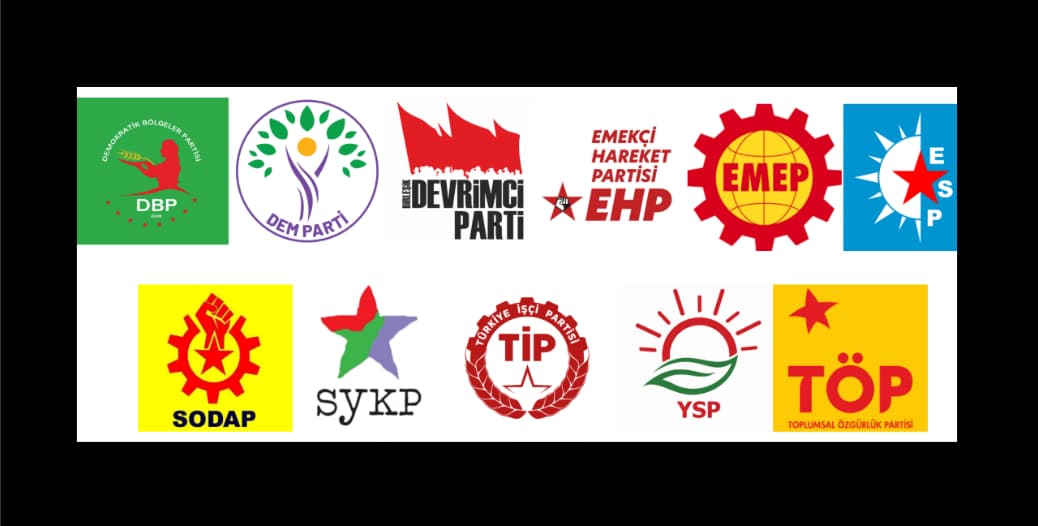
Eleven political parties in Turkey have issued a joint call urging the government to take urgent and concrete steps to advance what they describe as the “Peace and Democratic Society Process.” The statement was signed by the Democratic Regions Party, Peoples’ Equality and Democracy Party, Labor Movement Party, Labour Party, Socialist Party of the Oppressed, Platform for Socialist Solidarity, Socialist Refoundation Party, Workers’ Party of Turkey, Social Freedom Party and the Green Left Party.
According to the parties, the political process that has continued for over a year has reached a new stage and now requires practical measures rather than declarations of goodwill. They criticized the government for maintaining a security-focused approach and failing to implement reforms necessary for democratic normalization.
Main Demands to the Turkish State
The joint statement outlined the following concrete steps:
- Ending trustee appointments in municipalities and reinstating elected mayors removed from office without waiting for new legislation
- Implementing binding rulings of the Constitutional Court and the European Court of Human Rights, including decisions concerning Selahattin Demirtaş, Figen Yüksekdağ, Can Atalay, Osman Kavala and Tayfun Kahraman
- Improving prison conditions and legal safeguards for detainees and prisoners within the current legal framework
- Ending judicial pressure on opposition parties and removing threats of party closures or further trustee appointments
- Accelerating parliamentary work to adopt legal regulations necessary for democratization
- Removing legal and political barriers to democratization, including measures linked to transitional justice and democratic integration
The parties stressed that the peace process cannot advance solely through political rhetoric and called on democratic actors and civil society to mobilize in support of peaceful political change.
Absence of explicit reference to Kurdish collective rights
The joint declaration frames its proposals within the broader concepts of democratization, rule of law, and political normalization. However, the text does not explicitly mention Kurds or Kurdistan, nor does it clearly define demands related to recognition of Kurdish people as a collective political identity.
From the perspective of this news platform, the absence of explicit reference to Kurdish national recognition highlights an important gap between general democratic reform discourse and longstanding Kurdish expectations concerning collective political, cultural, and linguistic rights. While the demands focus on institutional reforms, legal guarantees, and political participation, they do not directly address questions related to recognition of Kurds as a distinct people within the constitutional and political framework.
