




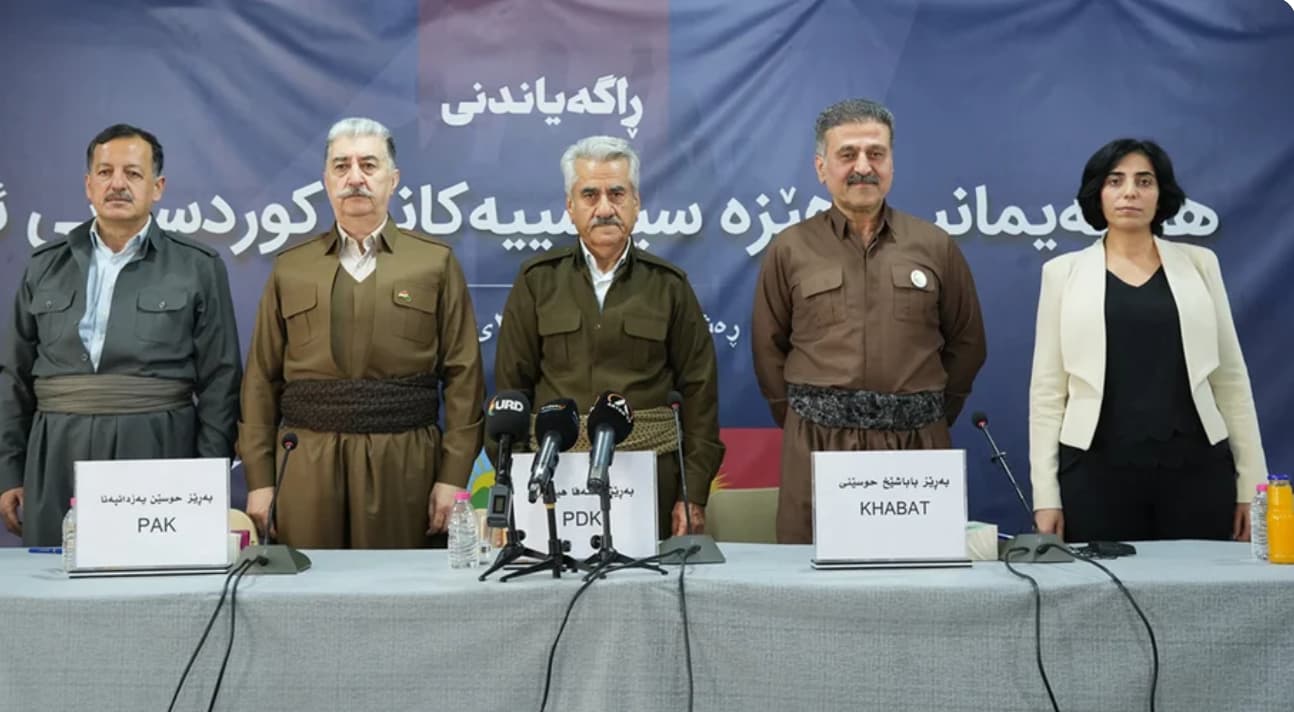
Several Iranian Kurdish opposition groups have announced the formation of a new political alliance, presenting it as an effort to coordinate strategy and strengthen their collective voice.
However, as The National Context reports, the coalition’s internal composition has prompted questions about how broadly it represents the diverse political and social landscape of Iranian Kurdistan.
PJAK’s distinct position
Among the five member parties, only the Kurdistan Free Life Party (PJAK) appears to have an organizational presence extending beyond a narrow geographic area.
According to The National Context, PJAK’s senior leadership reflects a more diverse background. While one prominent figure, Viyan, comes from a Kurmanji-speaking community, other figures — such as Revan Abadan — originate from Shia Kurdish areas like Ilam. This cross-regional and cross-sectarian representation gives PJAK a broader profile than its coalition partners.

Overlapping support bases
In contrast, the other four parties draw their leadership, cadres, and social base largely from the same cluster of Sorani-speaking Sunni towns. Rather than expanding the alliance’s geographic reach, they effectively compete within the same limited population pool.
As The National Context emphasizes, this overlap limits the coalition’s ability to claim wide-ranging representation across Iran’s Kurdish regions, which include diverse linguistic, sectarian, and urban constituencies.
A question of legitimacy
The report argues that a coalition claiming to represent the political forces of Iranian Kurdistan, while drawing almost exclusively from one demographic and geographic corner of it, faces a structural legitimacy challenge.
“No platform document, however well-drafted, can resolve” such a gap in representation, The National Context concludes.
While the alliance marks a step toward coordination among Kurdish opposition factions, its long-term credibility may depend on whether it can expand beyond its current base and incorporate a wider cross-section of Iranian Kurdish society.
