




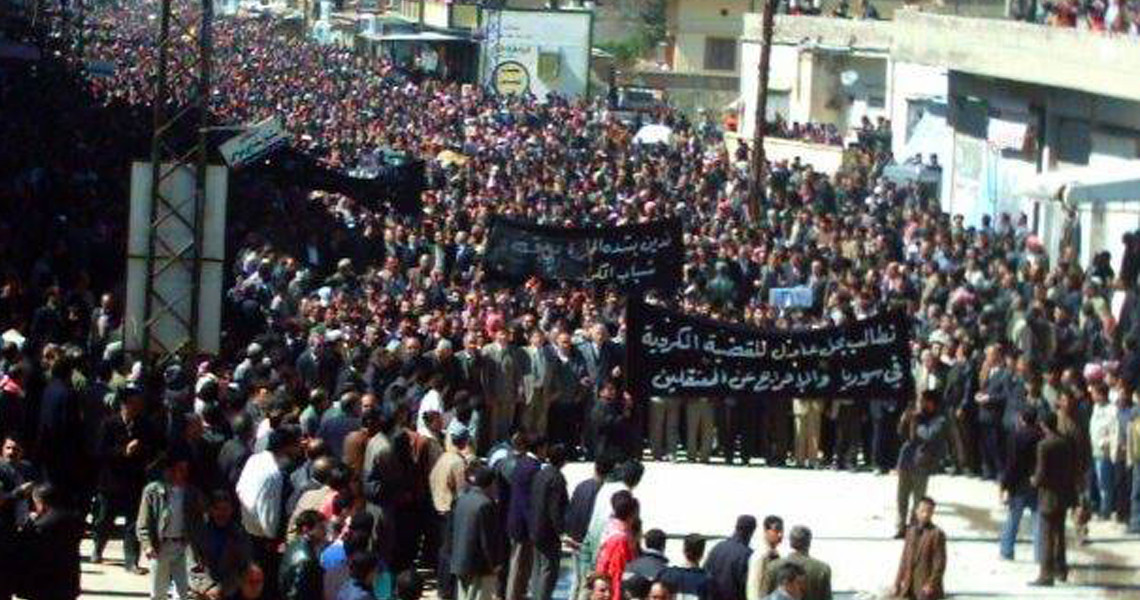
On March 12, 2004, tensions erupted during a football match in the northeastern Syrian city of Qamishli, where fans of a local Kurdish team faced supporters from Deir ez-Zor. Insults and clashes between the crowds escalated into violence, with stones and knives used in the stadium.
When Syrian security forces intervened, they opened fire on the crowd, killing several Kurdish spectators. The incident quickly spread beyond the stadium and ignited protests across the city.
Protests and crackdown
The following days saw mass demonstrations in Kurdish-majority areas across northern Syria, including Amuda, Afrin, and Kobane. Protesters attacked symbols of state authority, including a local Arab Socialist Ba’ath Party office and a statue of former Syrian president Hafez al-Assad.
The Syrian government responded with overwhelming force. Troops backed by tanks and helicopters moved into the region, imposing a security crackdown. At least 30 people—mostly Kurds—were killed, more than 160 were injured, and over 2,000 were arrested. Reports later documented torture and mistreatment of detainees.
Roots of long-standing grievances
The uprising did not emerge in isolation. Kurdish communities in Syria had long faced discrimination and marginalization. A controversial census in 1962 stripped many Kurds of citizenship, leaving hundreds of thousands without basic civil rights.
Government policies such as the “Arab Belt” resettlement program further deepened tensions by relocating Arab populations into traditionally Kurdish regions.
By 2004, these grievances had accumulated for decades, turning the Qamishli events into a powerful expression of Kurdish frustration with the state.
A lasting mark on Kurdish consciousness
In the aftermath, thousands of Kurds fled to neighboring Iraqi Kurdistan, while the Syrian government issued limited amnesties for some detainees. Yet the deeper impact of the uprising endured.
For many Syrian Kurds, the Qamishli uprising became a defining moment in modern Kurdish history. It was the first large-scale Kurdish protest movement in Syria and a turning point that reshaped relations between the Kurdish population and the Syrian state.
More than two decades later, the events of March 2004 remain etched in collective memory—symbolizing both repression and the awakening of Kurdish political consciousness in Syria.

