




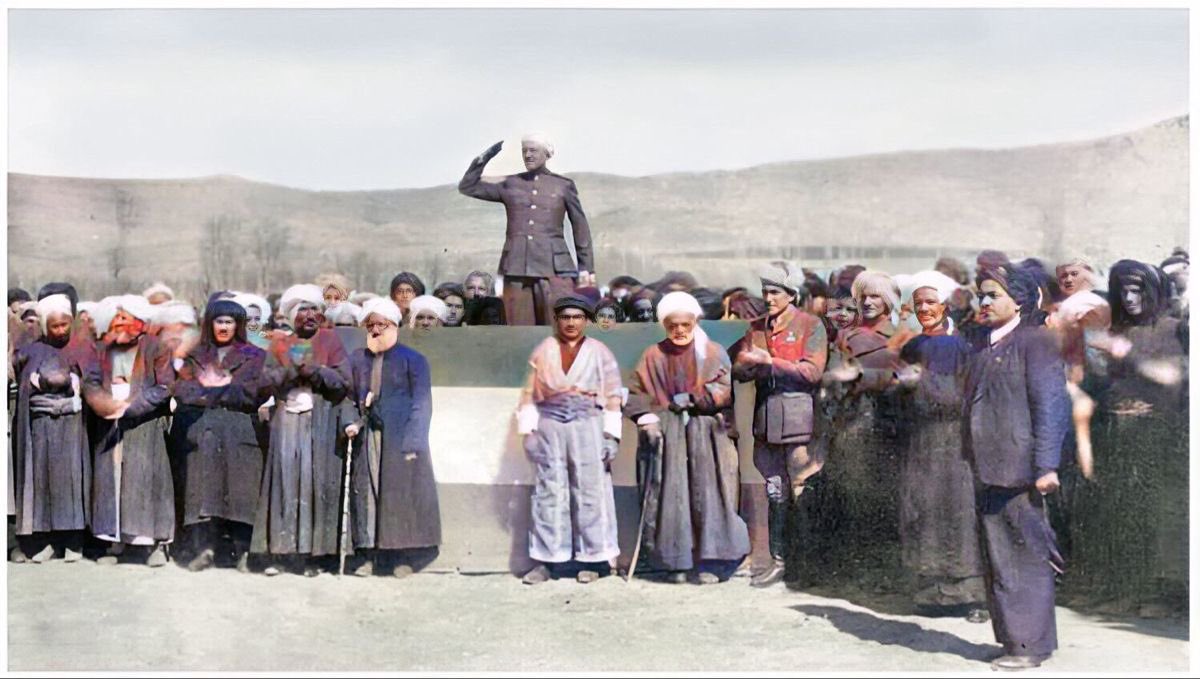
Qazi Muhammad occupies a central place in the history of Kurdish nationalism as the founder and president of the Republic of Mahabad. His political project emerged in a historical moment shaped by the end of World War II and the restructuring of international influence in the Middle East.
Following the defeat of Nazi Germany and its allies, the Allied powers expanded their geopolitical influence in countries that had strategic importance. Iran became one of the central arenas of this rivalry. The south of the country came under British influence, while the northern regions, including parts of Kurdish areas in Rojhilat (Iranian Kurdistan), experienced Soviet military presence. This division weakened central Iranian authority and created political space for minority groups, including the Kurds, to articulate demands for recognition and autonomy.
In this environment marked by crisis and international competition, Qazi Muhammad and a group of Kurdish intellectuals and political activists worked to transform Kurdish aspirations into a structured political project. The Republic of Mahabad, declared on 22 January 1946, represented the first modern Kurdish republic with institutions of governance, parliament, armed forces, and cultural policies promoting Kurdish identity.
Building a political vision for Kurdish nationalism
Born in Mahabad in 1893 into a respected religious family, Qazi Muhammad combined traditional Islamic scholarship with modern political awareness. Educated in Islamic jurisprudence, he became a judge (qazi), which gave him both social legitimacy and intellectual influence. He was fluent in Kurdish, Persian, Arabic, Turkish, and French, reflecting his openness to broader intellectual traditions.
From the early 1930s, Qazi Muhammad became involved in Kurdish political activism. He participated in the Xoybûn movement, founded in 1927, which aimed to coordinate Kurdish political efforts across borders. In 1945 he founded the Democratic Party of Iranian Kurdistan, marking an important shift from secret political circles toward an organized political party advocating democratic rights, decentralization, and peaceful coexistence with other peoples of Iran.
Qazi Muhammad’s political vision combined national consciousness with democratic principles. He emphasized the importance of education, social justice, and the fight against poverty and illiteracy. He believed that ignorance contributed significantly to the marginalization and suffering of Kurdish society, and therefore promoted education as a key foundation for national revival.
At the same time, Qazi Muhammad presented a model of Kurdish nationalism that respected religious diversity and tribal structures. Although he was an Islamic scholar, he established a largely secular political administration in order to ensure inclusivity for Kurds of different beliefs and to avoid sectarian divisions. This pragmatic approach allowed Kurdish nationalism to be framed as a political and cultural project rather than a purely religious movement.
The Mahabad Republic and the Kurdish national movement in the four parts of Kurdistan
The Republic of Mahabad quickly became a symbol of Kurdish political possibility across the four parts of Kurdistan: Rojhilat (Iran), Başûr (Iraq), Bakur (Turkey), and Rojava (Syria). The republic unified intellectuals, tribal leaders, and military actors around a shared national project.
The participation of Kurdish leader Mustafa Barzani and his forces demonstrated the emergence of cross-border Kurdish solidarity. This cooperation strengthened the idea that Kurdish identity transcended colonial borders drawn after the First World War.
The Mahabad Republic introduced Kurdish-language education, cultural institutions, and political representation. The Kurdish flag was raised publicly in Mahabad’s central square, marking an important symbolic moment in modern Kurdish history. Delegations from different Kurdish regions attended the declaration ceremony, illustrating the republic’s wider national significance.
However, the republic faced serious challenges. Regional powers such as Tehran and Ankara viewed Kurdish autonomy with suspicion. Economic pressure, political isolation, and the withdrawal of Soviet support in late 1946 weakened the young state. The Iranian government, under Mohammad Reza Pahlavi, imposed economic restrictions and later sent military forces to reassert control over the region.
Despite Qazi Muhammad’s attempts to negotiate autonomy within Iran, the central government refused compromise. By the end of 1946, the Republic of Mahabad had lost international backing and became vulnerable to military intervention.
Martyrdom and historical legacy
On 31 March 1947, Qazi Muhammad was executed by the Iranian government in Mahabad. His execution transformed him into a symbol of Kurdish resistance and political dignity. Reports indicate that he faced his execution calmly, maintaining his commitment to the Kurdish cause until the end of his life.
The legacy of the Republic of Mahabad continues to influence Kurdish political thought. For many Kurds, Mahabad represents a historical moment when Kurdish identity was institutionalized through education, governance, and political representation. The republic remains a reference point in discussions about Kurdish self-determination, federalism, and democratic autonomy.
Across the four parts of Kurdistan, Qazi Muhammad is remembered as a figure who attempted to reconcile tradition with modern political organization. His leadership contributed to the development of Kurdish nationalism as a collective political identity rather than a series of isolated uprisings.

