




By Necat Ayaz
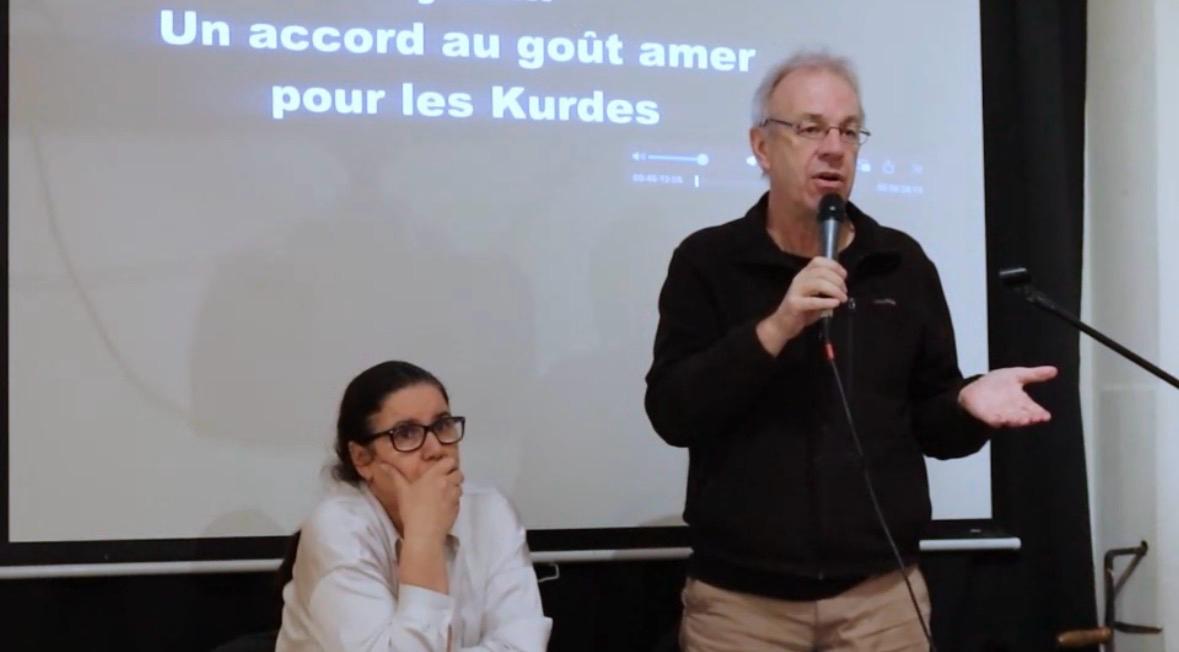
A solidarity event titled “Which Future for the Radical Democratic Experience of Rojava?” was held on 21 February at the community space Buen Vivir in Ixelles, Brussels. The gathering brought supporters of the Kurdish-led autonomous administration in northern Syria.
The evening featured a screening of the documentary “Un accord au goût amer pour les Kurdes” (An agreement with a bitter taste for the Kurds) by Flemish journalist Chris Den Hond, followed by a discussion with Den Hond and Hozan Ehmed from the Rojava Representation in Brussels.
First-hand observations from Rojava
Den Hond, who has visited the region multiple times since 2017, shared his impressions from Rojava during the January offensive by forces linked to the Syrian Interim Government.
He described the Rojava project as “a democratic, feminist and ecological revolution,” stating that he has followed developments closely over the years. According to him, the Kurdish-led administration represents a rare attempt at grassroots democracy in the region.
Kobani still under siege
Hozan Ehmed focused on the humanitarian and political situation in Kobani, which she said remains under siege and cut off from essential services.
She stressed that the city continues to suffer from shortages of water and electricity, despite ongoing negotiations. Kobani, she noted, has become an international symbol of Kurdish resistance—particularly because of its women fighters—and therefore remains a strategic and symbolic target.
Disagreements over YPJ and education
One of the key unresolved issues concerns the future of the YPJ (Women’s Protection Units). Ehmed explained that Syrian legislation does not currently allow women to serve as armed combatants in the national army.
“For us, this is a red line,” she said, emphasizing that YPJ fighters will not lay down their weapons without guarantees.
Education is another contentious issue. Since 2014, schools in the autonomous region have offered instruction in Kurdish, Arabic and Assyrian, allowing students to study in their mother tongue through university level. According to Ehmed, Syrian authorities have proposed limiting mother-tongue education to only a few optional hours per week—an offer she described as unacceptable.
Why the SDF withdrew?
Addressing the withdrawal of the Syrian Democratic Forces from parts of northern and eastern Syria, Ehmed pointed to shifting international dynamics. She argued that broader geopolitical agreements and Turkey’s indirect influence shaped the military balance on the ground.
Den Hond also underlined the strategic and economic importance of Aleppo for Turkey, describing the city as a longstanding economic objective for Ankara. In his view, Turkey opposes any form of Kurdish autonomy in the region.
A struggle beyond borders
Despite current setbacks, both speakers expressed confidence in the long-term resilience of the Kurdish political project. Den Hond emphasized what he described as its “internationalist and multi-communal ideology,” contrasting it with nationalist movements in the region.
The event concluded with a question-and-answer session, during which participants raised concerns about recent political developments, the humanitarian situation on the ground, and the prospects for a lasting political settlement in northern Syria.
In their closing remarks, the speakers placed the Rojava experience within a broader global context. They pointed to the rise of nationalist and authoritarian movements in many parts of the world, arguing that such trends pose challenges not only for the Kurdish movement but for democratic forces internationally. Despite these pressures, they maintained that grassroots organizing, international solidarity, and inclusive political models remain sources of resilience and hope for the future.

