





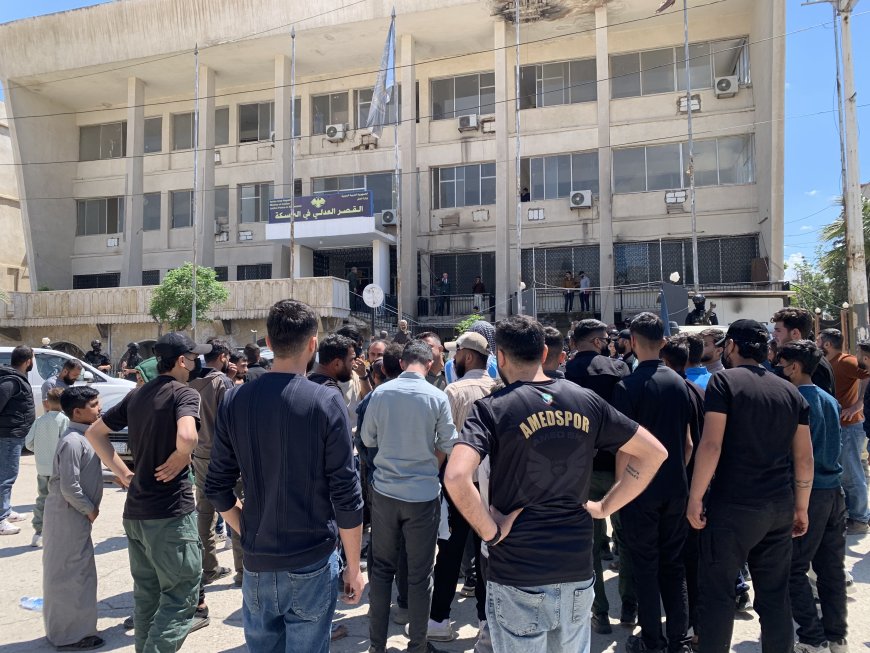
Syrian authorities on Thursday removed a bilingual Kurdish-Arabic billboard from the Justice Palace in the northeastern city of Hasaka, replacing it with a sign written in Arabic and English. The move triggered public anger in the predominantly Kurdish region known as Rojava, where residents gathered and chanted “Kurdistan” before later tearing down the newly installed billboard.
The controversy comes at a sensitive moment as negotiations continue over integrating Rojava’s civilian administrations and armed forces into Syrian state institutions following years of autonomous rule in northeast Syria.
The removal of Kurdish from the sign has fueled criticism because it appeared to contradict a recent presidential decree recognizing Kurdish as a national language. Syrian authorities have not publicly explained why Kurdish was excluded from the replacement billboard.
The incident also revived long-standing Kurdish concerns over state policies toward Kurdish identity and language in Syria. For decades under the rule of the Ba’ath Party, Kurdish language education and public cultural expression were heavily restricted. Kurdish place names were Arabized, many Kurds were denied citizenship after a controversial 1962 census in Hasaka province, and the public use of Kurdish in official institutions was often suppressed.
Since the outbreak of the Syrian conflict in 2011, Kurdish-led administrations in northeast Syria have expanded Kurdish-language education and public signage, making bilingual Kurdish-Arabic displays a symbol of local identity and self-rule.
A similar dispute recently occurred in the Kurdish-majority city of Kobane, where authorities initially installed locality signs only in Arabic before adding Kurdish following public criticism.
