






Key points
-
Mazloum Abdi attended the Munich Security Conference not as part of Damascus’s official delegation, with his participation coordinated through U.S. channels.
-
His joint appearances with senior U.S. officials were carefully staged to project progress on SDF–Damascus integration.
-
The Save the Kurds Act, introduced by Lindsey Graham and Richard Blumenthal, has weak political backing and functions more as rhetorical leverage than a likely enforcement tool.
-
U.S. policy signals support only for limited administrative decentralization within a unified Syria, not for a KRG-style autonomous region.
Mazloum Abdi’s appearance at the Munich Security Conference generated celebration in Kurdish political circles. But as The National Context emphasizes, the significance of the moment lies less in symbolism and more in the political choreography behind it.
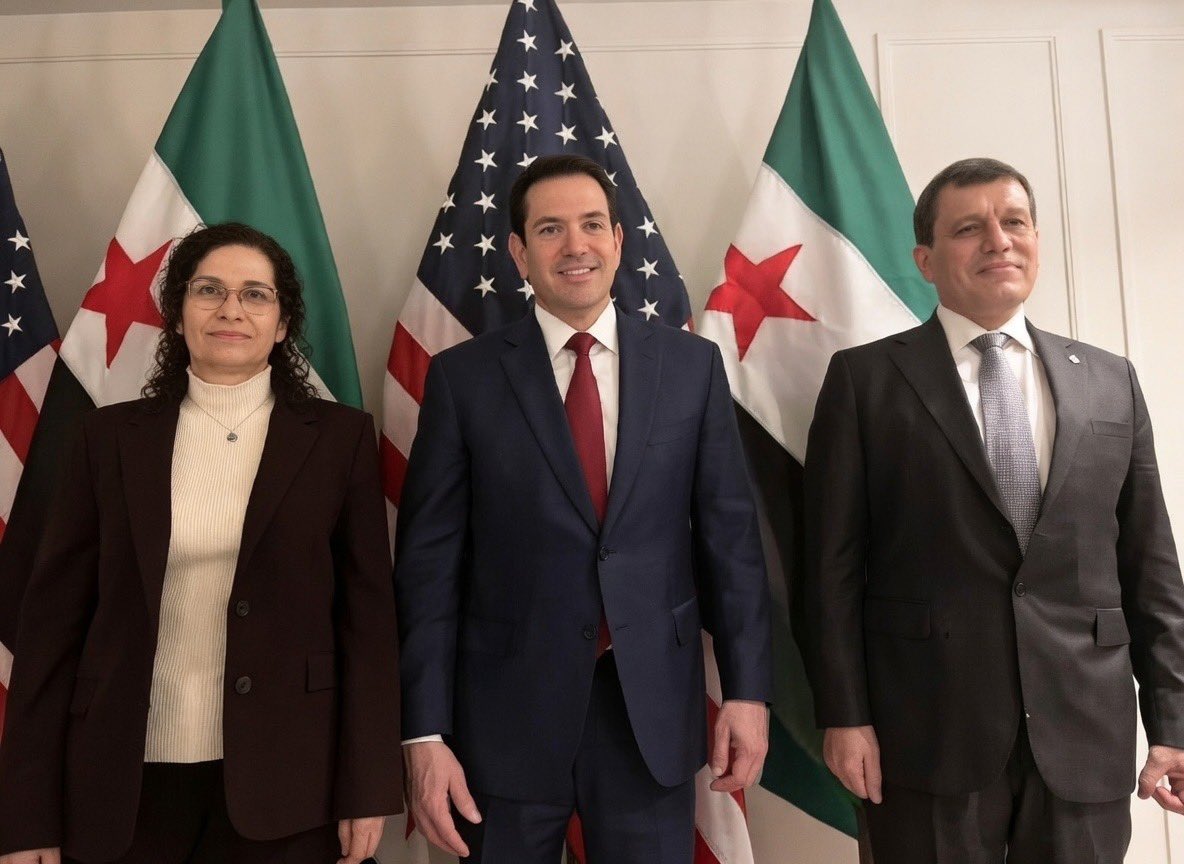
Abdi did not attend as part of Damascus’s official delegation. According to The National Context, his trip was coordinated through U.S. channels with Syrian government consent, undercutting later claims that he was simply folded into Foreign Minister Asaad al-Shaibani’s delegation. The arrangement signaled that both Washington and Damascus had an interest in Abdi being seen on the international stage — and in how that image would be interpreted.
His joint appearances with senior officials, including Secretary of State Marco Rubio and a Senate delegation projected a clear message: the SDF and Damascus are moving toward integration. As The National Context notes, this visual alignment was likely aimed as much at Congress as at regional actors, helping ease concerns about U.S. withdrawal and Damascus’s military advances.
The Save the Kurds Act: Symbolism over substance
The Munich optics also intersect with debate in Washington over the Save the Kurds Act, introduced by Lindsey Graham and Richard Blumenthal. In Kurdish circles, the bill has been viewed as reassurance. Yet, as The National Context argues, its political footing is weak.
The legislation lacks White House backing and has minimal congressional support. At the same time, Washington recently lifted sanctions on Syria without preconditions, underscoring a broader policy shift toward accommodation with Damascus rather than new punitive measures. In that context, the bill functions more as rhetorical leverage than as an imminent enforcement mechanism.
Autonomy — but within limits
Reporting cited by The National Context indicates U.S. officials have urged Ahmed al-Sharaa to allow “a degree of autonomy” for Kurds, provided it does not threaten central authority in Damascus. That framing points toward administrative decentralization within a unified Syrian state — not a KRG-style autonomous region.
Unresolved issues remain decisive: control of heavy weapons, key oil fields such as Rumeilan and Suwaydiyah, the Semelka border crossing, and authority in mixed cities like Hasakah and Qamishli. As The National Context stresses, these material questions — not conference appearances — will ultimately define the scope of any Kurdish self-rule.
Conditional restraint, not a guarantee
The clearest signal from Munich, according to The National Context, came from Rubio’s press remarks. Washington has urged a pause in attacks on the SDF to facilitate ISIS detainee relocation and implementation of an integration agreement. But that restraint is conditional. If integration stalls, U.S. opposition to renewed military pressure may fade.
With the SDF’s territorial control significantly reduced and U.S. forces drawing down, its leverage has narrowed. Geography further constrains options: much of what remains under SDF influence lies near the Turkish border, making Ankara a decisive actor. The broader geopolitical environment — in which Washington is less willing to strain ties with Turkey — further limits the ceiling of Kurdish autonomy.
Morale boost or turning point?
For Abdi and the SDF, Munich was not meaningless. As The National Context notes, after weeks of battlefield losses, high-level international visibility boosts morale and strengthens negotiating posture. Publicly framing the conference as an autonomy milestone also serves internal cohesion.
Yet the gap between celebratory rhetoric and structural realities carries risk. The likely outer boundary of any deal, The National Context concludes, is limited self-rule in predominantly Kurdish areas — not control over oil revenues, border crossings, or mixed strategic cities.
Whether Munich is remembered as a genuine opening or simply a morale moment will depend not on optics, but on who ultimately controls the oil fields and the Semelka crossing — the true pillars of meaningful autonomy.
